Elk Sign
Have you ever heard a hunter say something like, “That looks like a good elk spot,” or better yet, “that spot looks elky.” What exactly is it that these folks see, smell, taste, or imagine that tells them a particular area may have elk in it? In twenty plus years of hunting elk, I have yet to acquire whatever special sense that these individuals seem to think they have. Believe me, I have tried, but for me it just doesn’t seem to work. What does work is finding actual evidence that elk are currently in or have been in a particular area. Evidence spelled “SIGN” can be, tracks, beds, rubs, wallows, and my favorite poop, scat, milk duds...whatever you want to call it. All are indicators that elk have at some time passed through an area. Let’s briefly look at each. Tracks: Fresh elk tracks are crisp on the edges with good definition along the top edge of the indentation. Few if any debris is found within the track. Cow elk like to follow one another in single file, especially if they are climbing a hill, busting through deep snow or busting brush. If you happen to come upon a set of tracks single file, look off to either side for another single set of tracks paralleling the main body of tracks. This can indicated the presence of a bull as then often travel offset like this. Beds: Elk bed in areas offering security, water, food, and comfort. Elk will bed down in small groups. If the main group is large, say twenty or thirty animals, you may find six or seven smaller areas where the elk have settled in their small group. If the group consist mainly of cows as in the case of a harem during the rut, the bull may lay down offset to one side so that he can keep an eye on all of the smaller groups. Look for the single larger bed of a bull offset from the group. When elk rise they often urinate right in their bed. Due to their anatomy, a bull will pee in the center of his bed while a cow will pee near the edge of her bed. Checking for the location of a damp spot with your hand can give you a clue as to who was sleeping in the bed. Look for elk to generally bed on north or east facing heavily timbered slopes during September and October as this provides not only security but shade. Rubs: Bull elk use smaller trees and bushes to remove the velvet from their antlers. Some say that the bigger the bull, the bigger the tree. I have not always found that to be the case as I have witnessed huge 6x7 bulls beating the snot out of small bushes and saplings in their effort to remove velvet. Fresh rubs are almost white and there is little sap evident in the rub. Hair can be found stuck in the rub itself. If the exposed bark has discolored or yellowed or if sap is present, chances are that the rub is not that recent. If you find a number of trees with rubs in a general area, say within a 75-yard circle, that may be evidence of a larger bull. Wallows: Bull elk use wallows for all sorts of reasons. To cool off, to drink from (rarely), to just play in, or to urinate in and then mark. Wallows range from large muddy areas that are really torn up to smaller holes maybe only a couple of feet across. Some may contain a significant supply of water other may have little visible water at all. Most do have one thing in common however regardless of size, the musky smell of elk urine. Recently used wallows are very aromatic, have fresh tracks and visible water is murky. Wallows that are still being used can be excellent places to set up a ground blind. Always look for the wind when considering where to setup. Poop: Fresh, wet, green poop on dry ground is a near sure sign that elk were or are in the area. On dry ground elk poop dries out rather quickly...a matter of hours. Really fresh stuff may even have a shine to it as the outside is still wet. VERY fresh sign will have an elk standing over it. Ha ha couldn’t resist. If elk have shifted their diet from graze (grasses) to browse (bushes and limbs) fresh droppings may be brown in color rather than green. Dry black droppings are old. How old? Too old to matter. Cow elk droppings are tapered on both ends whereas bull elk poop has a dimple or concave look to one end. Finally elk under stress scatter their poop as opposed to the poop of elk under less stress may clump together. Bulls produce big clumps. Those who seek knowledge kill more elk than those who do not! For a lot more information on elk and elk hunting please consider purchasing one or all of my top-selling books on the subject on Amazon.com. |
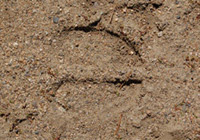
Bull Elk Track
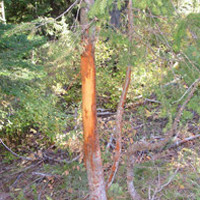
Elk Rub
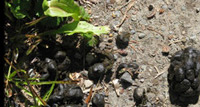
Poop, Scat, Droppings
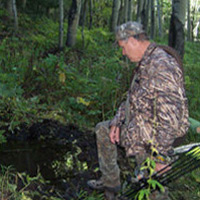
Elk Wallow,
My friend Andy Farris
|
|
This document may contain copyrighted material whose use has not been specifically authorized by the copyright owner. ElkCamp.com is making this information available for the purposes of criticism, comment, news reporting, teaching, scholarship, and research. We believe that this constitutes a 'fair use' of the copyrighted material as provided for in section 107 of the U.S. Copyright Law.
|
ElkCamp is a registered trademark. All use is reserved. |